
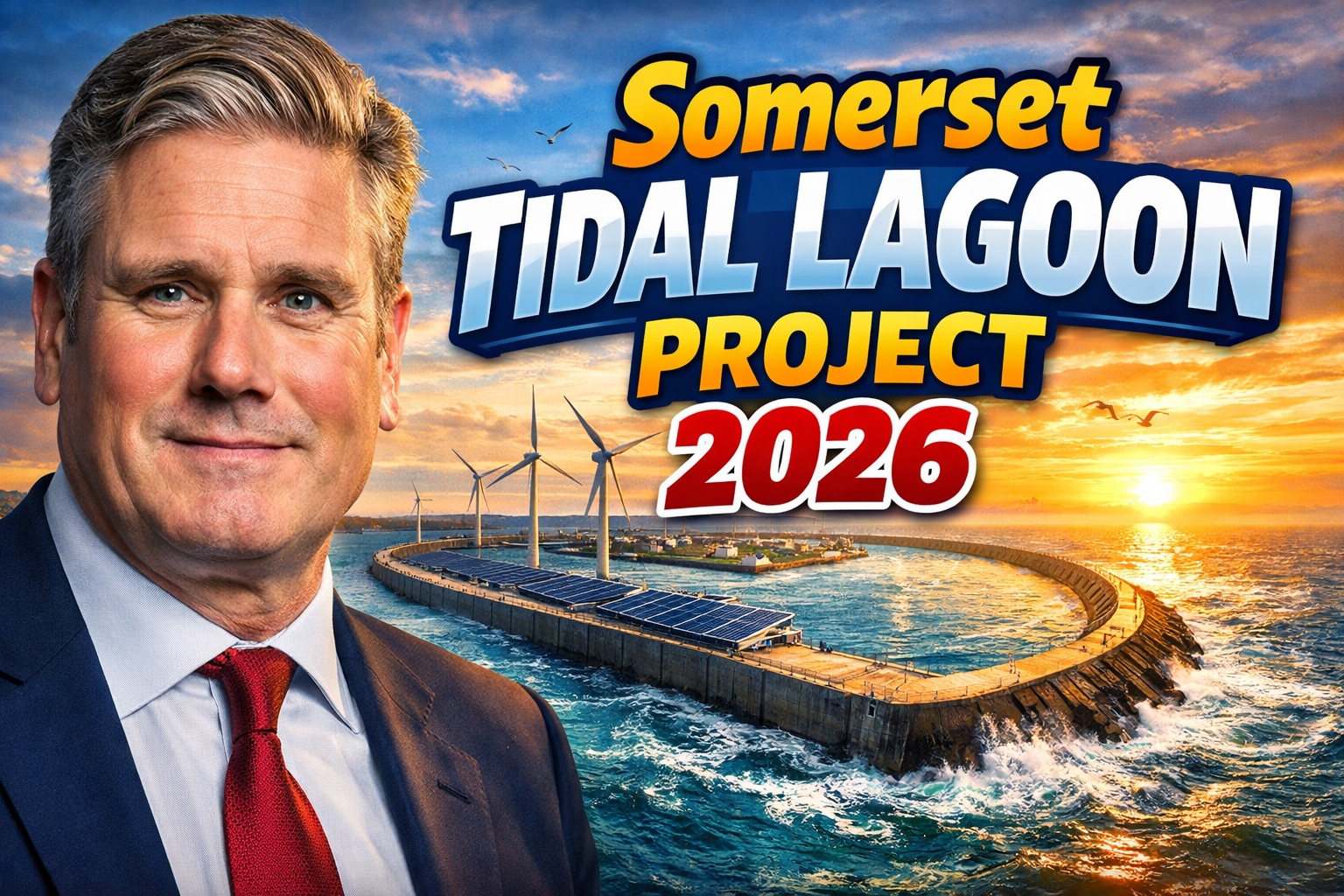
The West Somerset Tidal Lagoon project has gained fresh momentum in early 2026, with local MP Rachel Gilmour formally requesting a meeting with Prime Minister Keir Starmer to champion this ambitious renewable energy initiative. Spanning from Minehead to Watchet along the Bristol Channel, the proposed fourteen-kilometer semi-circular barrier promises to harness the world’s second-highest tidal range, generating clean power for two million homes over a century-long lifespan. This development arrives amid Britain’s urgent push for energy security and net-zero goals, positioning Somerset as a potential hub for tidal innovation.
Project Origins and Vision
Conceived by a consortium including London Eye architect Julia Barfield, retired engineer Chris Binnie, and local advocate Steve Pickard, the West Somerset Lagoon revives tidal lagoon concepts shelved years ago. Unlike earlier full-estuary barrage proposals, this design arcs outward from the Somerset coast, enclosing a vast water body without blocking vital shipping lanes to Bristol and Cardiff. The structure integrates one hundred twenty-five underwater turbines that capture tidal flows twice daily, driven by gravitational forces amplified by the channel’s extreme range—up to fifteen meters.
Proponents envision a multi-faceted landmark: a public walking and cycling path atop the wall, a three hundred-berth marina, watersports facilities, a lido, and an observation tower. Data centers cooled by seawater could nestle within, boosting efficiency for the AI-driven energy demands of tomorrow. At an estimated eleven billion pounds—roughly a third of Hinkley Point C’s cost—the project pledges reliable baseload power, outlasting nuclear plants and sidestepping wind and solar intermittency.
The consortium argues long-term economics favor tidal, with operational costs plummeting over one hundred twenty years, potentially undercutting fossil fuels and nukes per kilowatt-hour.
Technical Specifications
The lagoon’s engineering marvels center on robust seawalls built from locally sourced materials, resistant to corrosion and storms. Turbines, similar to those in successful La Rance or Sihwa Lake projects, generate during both ebb and flood tides, yielding predictable output unaffected by weather. Peak capacity hits gigawatt scale, feeding the grid via undersea cables linked to onshore substations.
Environmental modeling claims minimal marine disruption, as the design sits outside protected zones and allows fish passage. Construction phases span a decade, starting with site surveys and geotechnical drills, followed by caisson placements and turbine installs. Peak workforce could exceed five thousand, injecting vitality into rural economies.
Flood defenses double as benefits, shielding coastal communities from rising seas—a dual boon in climate-vulnerable Somerset.
| Component | Details | Capacity/Benefit |
|---|---|---|
| Lagoon Wall | 14 km semi-circular | Tidal containment |
| Turbines | 125 units | Power for 2M homes |
| Marina | 300 berths | Tourism/jobs |
| Pathways | Pedestrian/cycling | Recreation |
| Data Centers | Seawater-cooled | Efficiency gains |
Economic and Job Impacts
For West Somerset—ranking low on social mobility indices—the lagoon promises transformation. Direct construction jobs number thousands, with ongoing operations sustaining hundreds in maintenance, tourism, and tech. Community infrastructure levies and Section 106 agreements could fund road upgrades like the B3191 Watchet-Blue Anchor stretch, easing traffic and boosting connectivity.
Ripple effects extend to supply chains: steel from Scunthorpe, aggregates locally, and tech from Bristol’s hub. Visitor spending at the marina and lido rivals Exmoor national park draws, diversifying beyond seasonal tourism. Data centers attract firms fleeing high-energy urban costs, creating high-skill roles.
Over decades, revenues from power sales and levies repay investment, yielding net positives for taxpayers versus imported gas.
Environmental Advantages
Tidal energy shines for predictability—lunar cycles ensure output years ahead, unlike variable renewables. Lifecycle emissions near zero, with recyclable turbines post-century. Biodiversity studies predict enhanced habitats: artificial reefs foster fish stocks, while bird perches atop the wall aid species like oystercatchers.
Unlike offshore wind farms, visual impacts stay coastal, blending into the seascape. Cooling data centers with seawater slashes energy waste, aligning with net-zero data ambitions. Proponents counter past Swansea Bay critiques by scaling economically and dodging estuary blockages.
Somerset’s peatlands and wetlands nearby gain indirect protection via displaced fossil reliance.
MP Rachel Gilmour’s Advocacy
West Somerset MP Rachel Gilmour penned a compelling letter to Starmer in early January 2026, urging a direct meeting to propel plans forward. She hailed the project as «iconic national infrastructure» with «transformational potential,» contrasting its modest cost and longevity against pricier alternatives. Gilmour spotlighted local growth levers—jobs, amenities, road fixes—and its role powering two million homes reliably.
Her push follows consortium briefings, positioning her as bridge between constituents and Whitehall. Gilmour envisions Somerset rivaling Scotland’s renewables, urging swift government backing for planning and funding.
No. 10 response pends, but precedents like Swansea suggest open ears.
Government Response and Policy Context
The Department for Energy Security and Net Zero welcomes «well-structured tidal proposals demonstrating value for money,» amid soaring demands from electrification and AI. Labour’s Great British Energy vehicle eyes tidal as dispatchable clean power, complementing wind farms.
Past rejections—like Swansea Bay’s 2018 shelving over costs—haunt, but post-Ukraine energy crises shift calculus. Hinkley Point C overruns underscore tidal’s appeal: fixed-price, long-life. Planning falls under Nationally Significant Infrastructure Projects, fast-tracking via Development Consent Orders.
Starmer’s clean power 2030 pledge demands bold moves; Somerset fits as flagship.
Historical Precedents
Tidal lagoons trace to failed Severn Barrage dreams of the nineteen seventies, thwarted by costs and ecology. Swansea Bay, championed by First Minister Carwyn Jones, secured initial funds but crumbled on subsidies. Smaller pilots like MeyGen in Scotland succeed modestly, validating tech.
Somerset’s Bristol Channel boasts unmatched range—only Canada’s Bay of Fundy tops it—begging exploitation. Global peers: France’s La Rance thrives since nineteen sixty-six, South Korea’s Sihwa since two thousand ten.
Lessons refine Somerset: modular builds, private funding, multi-use.
Challenges and Criticisms
Skeptics flag upfront capital—eleven billion requires public guarantees or innovative finance like green bonds. Environmental groups worry sediment shifts harming Severn estuary SACs, demanding rigorous EIAs. Shipping interests scrutinize navigation, though designs detour.
Local fishers fear turbine snags; mitigations include slow-speed zones. Cost overruns plague megaprojects—Hinkley triples budgets—risking taxpayer exposure.
Consortium counters with bankable models, phased risks, and private leads.
Funding Models Explored
Private investment heads, with pension funds eyeing stable yields. Government could backstop via Contracts for Difference, pegging prices to offshore wind. Community shares empower locals, echoing Scottish hydro successes.
Export credits for turbine tech and levies fund local mitigations. Blended finance—public seed, private scale—mirrors Sizewell C.
Community Engagement
Minehead and Watchet councils back via resolutions, hosting public halls. Taskforces blend iwi-like indigenous input with Exmoor stakeholders. Youth forums pitch jobs training, ensuring inclusive growth.
Opponents voice via petitions, but polls show majority renewable support.
Comparison to Alternatives
Versus Hinkley C: third the cost, quadruple lifespan, zero waste. Beats wind: constant output, no blades killing birds. Nuclear risks absent; gas emissions nil.
| Metric | Somerset Lagoon | Hinkley Point C | Offshore Wind |
|---|---|---|---|
| Cost (£Bn) | 11 | 35+ | Varies |
| Lifespan (Yrs) | 120 | 60 | 25 |
| Annual Output (TWh) | ~10 | ~25 | Site-dependent |
| Predictability | High | High | Low |
Regional Development Boost
Somerset sheds «left-behind» tags: marinas revive ports, paths link national trails, lidos draw day-trippers. Data hubs spawn startups, mirroring Cambridge tech clusters. Road funds unlock housing, easing affordability.
Tourism multipliers—think Eden Project—promise sustained GDP lifts.
Next Steps Post-Request
Gilmour eyes Downing Street summit, followed by DCO application. Feasibility grants precede full planning. Consortium courts investors, targeting financial close by twenty twenty-eight.
Construction starts twenty thirty, power by thirty-seven—aligning net-zero timelines.
Broader UK Energy Strategy Fit
Tidal slots into Labour’s 2030 clean grid: dispatchable backbone for intermittent solar-wind. Deploys Great British Energy’s mission, creates supply chain champions. Bolsters energy independence post-Russia.
Somerset pilots scalable lagoons nationwide—Liverpool Bay next?
Global Tidal Landscape
UK trails France, Korea; Somerset catapults leadership. China builds colossal barrages, but modular lagoons suit democracies. Tech exports to India, Chile beckon.
Potential Roadblocks
Planning delays, NIMBYism, fiscal squeezes loom. Election cycles sway priorities. Climate urgency counters inertia.
Optimistic Outlook
Gilmour’s request galvanizes hope: Starmer’s meeting could unlock era-defining project. Somerset stands ready to power Britain renewably, proving tides turn for good.

Nikhita Jose is a journalist and content writer covering local news, community affairs, and public interest stories in Somerset. She focuses on clear, accurate reporting and brings a thoughtful, reader-first approach to regional journalism.