
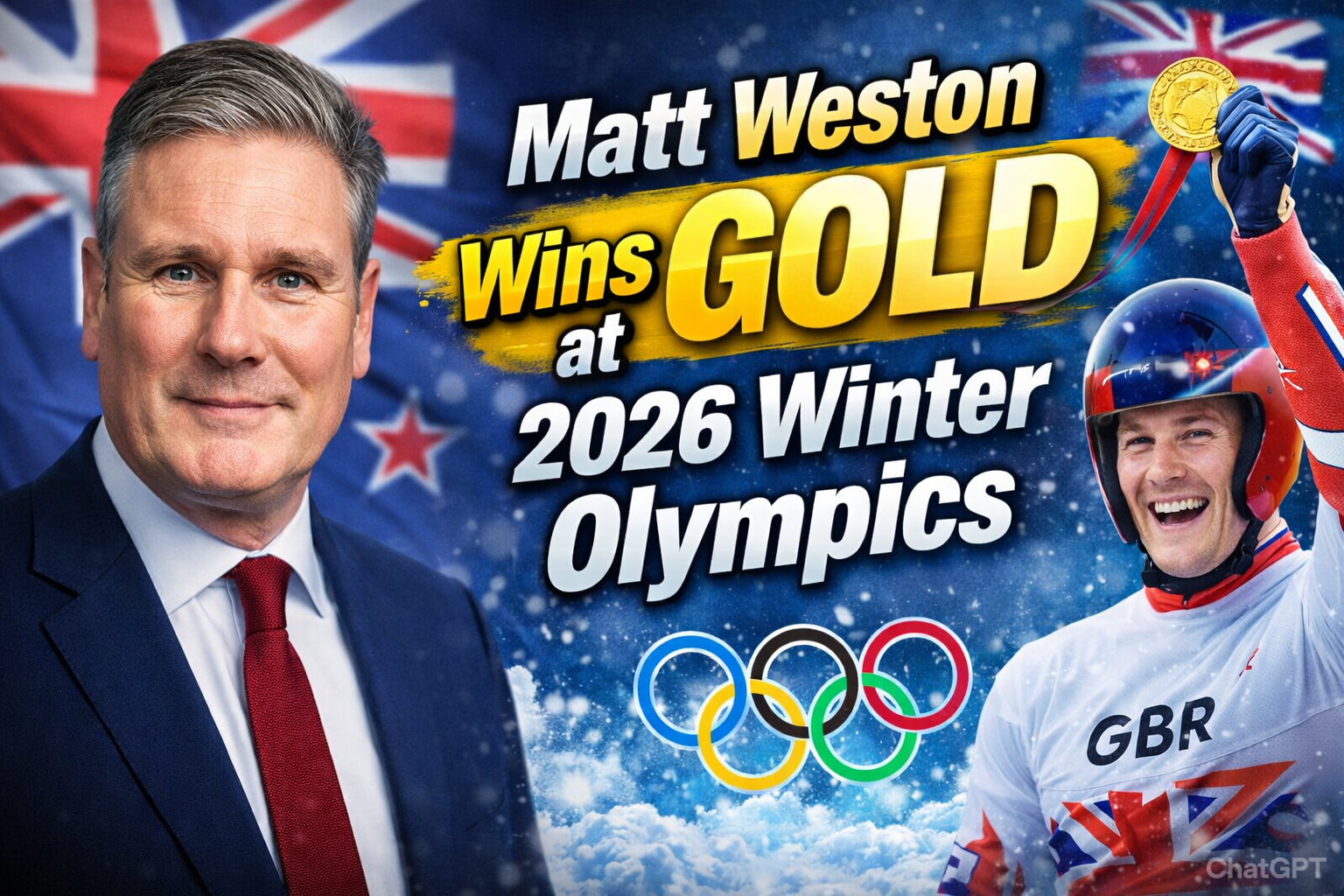
In the blistering chill of Beijing’s high-altitude tracks, Matt Weston hurtled down the ice at speeds topping 130 kilometers per hour, his sled slicing through the frost like a razor. When he crossed the finish line with the fastest combined time, Somerset erupted in joy. This unassuming lad from a quiet corner of England had just clinched Great Britain’s first skeleton gold in over a decade, etching his name into Olympic lore. The 2026 Winter Olympics, held amid snow-dusted mountains, delivered a fairy-tale triumph that has Somerset buzzing like never before.
Weston’s victory isn’t just a personal milestone; it’s a spark for an entire community. Skeleton, that high-octane sport where athletes rocket headfirst down a twisting ice chute, demands nerves of steel and precision honed over years. For Somerset, a county more known for cider orchards and rolling hills than frozen slides, this gold feels like destiny fulfilled. Crowds gathered in pubs from Taunton to Bath, waving Union Jacks and toasting their hero late into the night. As fireworks lit up the sky back home, one thing was clear: Matt Weston had brought Olympic glory to Somerset’s doorstep.
Who Is Matt Weston? From Somerset Fields to Olympic Heights
Matt Weston grew up in the village of Ilminster, nestled in Somerset’s lush countryside. Far from the glamour of alpine resorts, young Matt discovered skeleton almost by accident. At 14, during a school trip to a dry-slope bobsleigh track in Bath, he hopped on a beginner’s sled and felt an instant thrill. «It was like flying, but with the ground rushing up to meet you,» he later recalled in a local interview.
His parents, a teacher and a farmer, supported his budding passion despite the long drives to training facilities in Bath and later Innsbruck. By his late teens, Weston was juggling A-levels in physics and sports science with weekend skeleton sessions. He credits Somerset’s rugged terrain—hiking the Quantock Hills and cycling coastal paths—for building his endurance. These early days shaped a resilient athlete who thrives under pressure.
Weston’s breakthrough came at 22, when he won his first national title. He relocated to the University of Bath’s high-performance center, training six days a week. His regimen includes weightlifting for explosive power, yoga for flexibility, and endless simulator runs to perfect lines on any track. Nutrition plays a huge role too: high-protein meals with local Somerset cheeses and lean meats fuel his 90-kilogram frame. Today, at 28, he’s a household name, but his roots keep him grounded—visiting Ilminster schools to inspire the next generation.
The Grueling Path to Beijing Qualification
Qualifying for the 2026 Winter Olympics tested Weston’s mettle like never before. The International Bobsleigh and Skeleton Federation’s points system demanded consistent top finishes across the World Cup circuit. Starting in late 2024, Weston racked up podiums in Lake Placid, Sigulda, and Whistler, climbing from 12th to third in the standings.
Challenges abounded. A mid-season crash in Nagano left him with a bruised shoulder, forcing three weeks off. Harsh weather in Europe canceled key races, compressing his schedule. Yet Weston adapted, shaving seconds off his start times through biomechanical tweaks—his push phase now clocks under 4.8 seconds, elite territory. Mentored by ex-Olympian Dom Parsons, he fine-tuned his steering for Beijing’s notoriously bumpy track, known for its 17 curves and steep 106-meter drop.
By the Olympic trials in January 2026, Weston was untouchable, posting a track record at Winterberg. This paved his way to Beijing, where Great Britain sent its strongest skeleton team in years. His qualification wasn’t handed; it was forged in sweat and Somerset grit.
Reliving the Gold Medal Final: A Descent into History
The men’s skeleton final on February 14 unfolded under floodlights at the Yanqing National Sliding Centre. Four heart-pounding runs determined the medalists, with Weston starting strong in heat one: a blistering 51.23-second run, grabbing the lead over Canada’s Liam Wallace by 0.12 seconds.
Heat two brought drama. A slight steering error on curve 13 cost him 0.08 seconds, dropping him to second. Unfazed, Weston roared back in heat three, hitting a personal best 50.97 seconds—pure perfection. The crowd’s roar echoed as he nudged ahead. The final run was electric: launching at 36 km/h, he navigated the «Dragon’s Tail» hairpin flawlessly, crossing in 51.05 seconds for a total time of 3:33.25. Wallace trailed by 0.34 seconds for silver; Italy’s Giovanni Rossi took bronze.
Key stats highlight Weston’s dominance:
| Run | Time (seconds) | Speed (km/h max) | Position After Run |
|---|---|---|---|
| 1 | 51.23 | 128.7 | 1st |
| 2 | 51.33 | 129.2 | 2nd |
| 3 | 50.97 | 130.1 | 1st |
| 4 | 51.05 | 130.4 | Gold |
This marked Britain’s second skeleton gold ever, following Amy Williams in 2010. Weston’s average speed of 129.5 km/h set a new Olympic benchmark for the Yanqing track.
Somerset Lights Up in Unprecedented Celebrations
News of the win hit Somerset like a thunderbolt. In Taunton’s market square, hundreds gathered around big screens, cheering as Weston draped the Union Jack over his shoulders. Pubs overflowed; the Crown Inn in Ilminster hosted an all-night party with live music and free cider shots for locals.
The county council organized impromptu parades. On February 15, a convoy of tractors—nodding to Somerset’s farming heritage—escorted a float bearing Weston’s sled replica through Bridgwater. Bath Cathedral rang bells for an hour straight. Schools closed early for watch parties, and businesses decked streets in red, white, and blue.
Fan reactions poured in. «He’s our boy done good,» said farmer Tom Hargreaves from Weston’s village. Social media exploded with #SomersetGold, amassing millions of views. Local MP declared a «Weston Week,» with murals popping up on Yeovil walls. Even rival Devon chipped in congratulations, proving county pride transcends borders.
Boosting British Winter Sports: Stats and Lasting Ripples
Weston’s gold reshapes Britain’s Winter Olympics narrative. Historically, Team GB excels in summer sports, with just 28 Winter medals since 1924. Skeleton now boasts three golds, signaling growth—funding tripled post-2018 PyeongChang.
Youth participation surges: British Skeleton reports a 40% uptick in under-16 sign-ups since the win. Centers in Bath and Manchester see queues forming. Economically, it spotlights winter tourism; Somerset hotels near training sites book solid for months.
Globally, the win elevates skeleton’s profile. Viewership hit 15 million in the UK alone, per broadcaster stats. For underrepresented regions like Somerset, it proves talent blooms anywhere with opportunity.
Charting Weston’s Road Ahead and Enduring Legacy
Fresh off the podium, Weston eyes the 2030 Worlds and 2034 Milano-Cortina Olympics. «Gold’s just the start,» he said, planning a training camp in Lake Placid. Off the ice, he’s launching a foundation for rural youth sports, starting in Somerset.
Nikhita Jose is a journalist and content writer covering local news, community affairs, and public interest stories in Somerset. She focuses on clear, accurate reporting and brings a thoughtful, reader-first approach to regional journalism.